
ecenticecentic
How it worksResourcesPricingBlog
Install now
ASCII-art illustration of a stack of books

Best AI Attribution Tools for Ecommerce Marketing in 2026

Published: September 6, 2026 · 16 min read

Buying guide for ecommerce teams. Compare best AI attribution tools that join SKU-level revenue, surface AI-agent discovery, and prioritize first-party...

00

Introduction

AI attribution tools title card illustration

For ecommerce and DTC teams, the strongest approach isn’t any single vendor. It’s an AI-enabled attribution stack that joins product-level revenue data to every touchpoint, including AI shopping agents like ChatGPT and Gemini. Product-heavy sellers should prioritize platforms that unify SKU-level revenue with first-party event capture over generic multi-touch dashboards, because that combination is what actually explains why a sale happened.


TL;DR:

  • Tools that unify SKU-level revenue with first-party event data outperform generic dashboards for explaining sales, especially in product-heavy stores.
  • AI-first attribution platforms are ideal for small to medium ecommerce brands using Shopify or WooCommerce, with fast setup and limited cross-channel features.
  • Implementation success relies on thorough data mapping, baseline pilots, and weekly revenue reconciliation, with early validation crucial to avoid stalls.
  • Technical accuracy depends on server-side event capture, deterministic identity stitching, and revenue joins across all purchase channels.
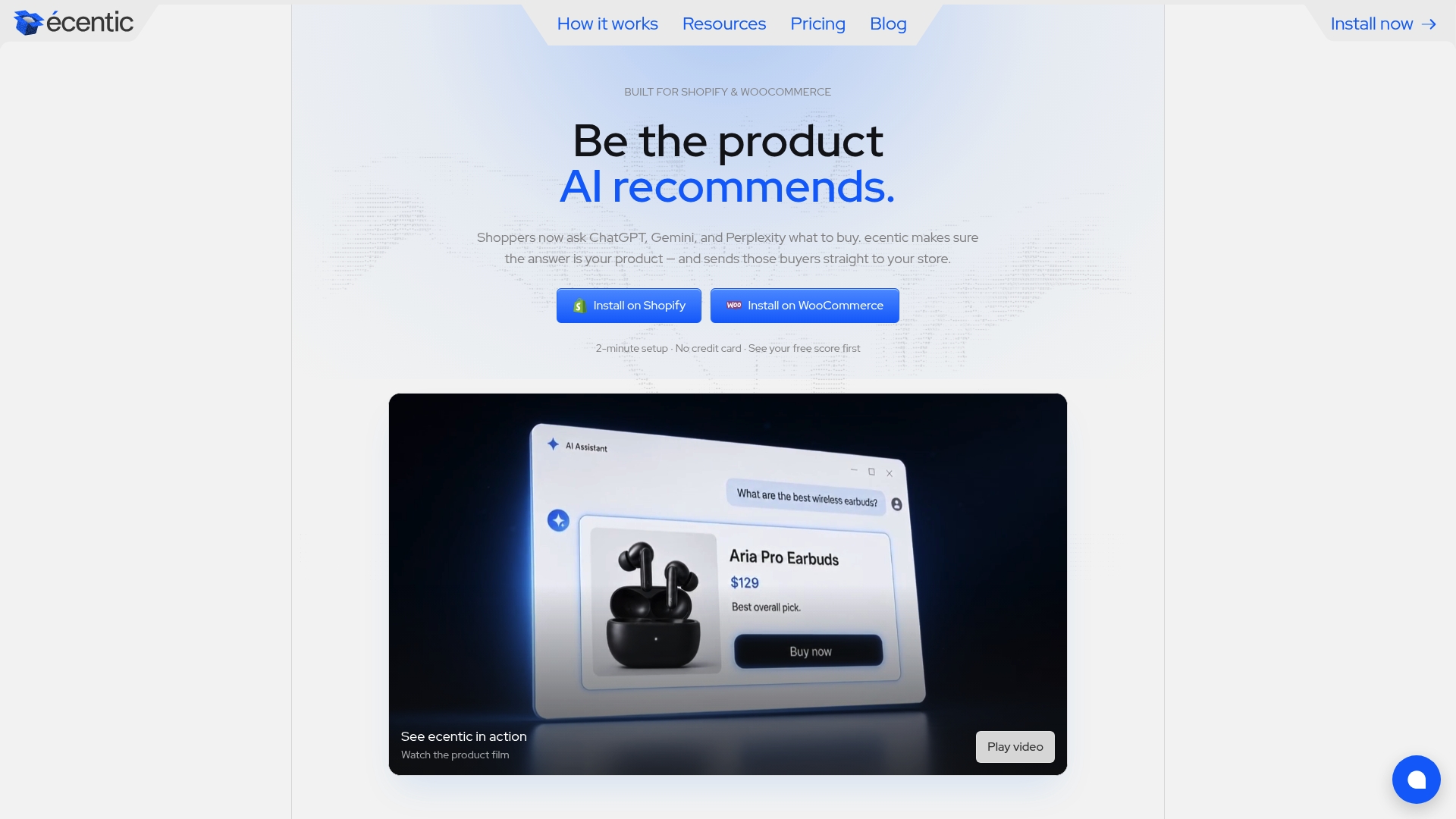
  • For AI agent-driven traffic, specialized tools like Ecentic provide product-level insights and optimize listings based on how AI shopping agents evaluate product pages.
Ecentic
ecentic.ai
See How AI Evaluates Your Listings
Ecentic connects to Shopify or WooCommerce to show strengths, weaknesses, and recommendations for improving product visibility in AI shopping agents.
Explore Ecentic
01

Which Category of Best AI Attribution Tools Fits Your Business?

Which Category of Best AI Attribution Tools Fits Your Business?

Not every ecommerce team needs the same architecture. The right category depends on catalog size, team resources, and whether AI-agent traffic already shows up in your analytics. Industry roundups agree there’s no single best AI attribution tool — the right pick depends on how well it closes the specific data gaps your funnel has, and for ecommerce that almost always means product-level joins and server-side capture.

Here’s how the major categories break down:

  • AI-first ecommerce attribution platforms. Built specifically for Shopify and WooCommerce stores, these tools connect order data to marketing touchpoints at the SKU level. Best for DTC brands under 50,000 monthly orders that need fast setup without a data engineering team. The trade-off: they often lag on cross-channel B2B pipeline features.
  • Enterprise multi-touch attribution suites. These handle massive data volumes across web, app, and offline channels with heavy customization. Best for large retailers with dedicated analytics staff. The catch is implementation time, often measured in months rather than weeks.
  • Analytics-plus-warehouse setups. Teams that pipe raw event data into Snowflake or BigQuery and build custom attribution models on top get maximum flexibility. Best for organizations with in-house data science talent. The trade-off is that you’re building, not buying, so time-to-insight is slower.
  • Ad-optimization add-ons. These plug into ad platforms like Meta or Google Ads to reallocate budget based on attribution signals but rarely touch product-level revenue. Best for teams whose main goal is spend efficiency, not deep funnel analysis.
  • AI shopping agent visibility tools. A newer category focused specifically on how ChatGPT, Gemini, Claude, and Perplexity recommend products, tracking agent-driven traffic and tying it back to conversions. Best for brands seeing early but unmeasured traffic from AI assistants.

For a first pilot, pick one category and test it against a single revenue goal. If you’re an ecommerce brand wondering whether AI agents are already influencing purchases, start there before expanding into full multi-touch modeling. Trying to solve every attribution problem in one pilot is how most rollouts stall.

02

How Do You Choose the Right AI Attribution Tool?

How Do You Choose the Right AI Attribution Tool?

Choosing well means ranking your criteria before you ever sit through a demo. Vendors are good at making every feature sound essential. Your job is to know which ones actually move the needle for your funnel.

  1. Start with data sources and identity resolution. Ask exactly which sources a vendor ingests natively: Shopify orders, Klaviyo email events, Meta and Google ad platforms, CRM records. Then ask how it stitches a single customer across devices and sessions. A tool with elegant dashboards but a 40% identity match rate will always undercount real revenue.
  2. Test model transparency next. Can the vendor show you, in plain language, why a specific channel got credit for a specific sale? Explainability and the ability to run multiple models in parallel (like last-touch alongside an AI incremental model) let you sanity-check results instead of trusting a black box.
  3. Check integration depth, not integration count. A vendor listing 200 integrations means little if only 10 are native and the rest require custom webhooks. Ask directly: “Which integrations are native versus custom, and what’s the setup time for each?”
  4. Ask for match-rate benchmarks by source. A credible vendor will tell you their typical match rate for server-side web events versus email click data versus offline POS. If they can’t produce a number, that’s a signal.
  5. Confirm flexibility for your funnel shape. B2B pipeline attribution and ecommerce product-level attribution need different modeling logic. Make sure the tool wasn’t built for one and retrofitted for the other.
  6. Review privacy and consent handling. Ask how the platform handles consent signals and whether it supports server-side capture to reduce data loss from ad blockers and privacy browsers.

On cost, expect two common shapes: flat monthly subscription tiers that scale with order volume or event count, and volume-based pricing tied to a percentage of attributed revenue. Implementation costs vary widely. A Shopify-native tool with pre-built connectors can go live in one to two weeks. An enterprise suite requiring custom data pipelines can take two to four months before you see reliable output. Budget accordingly, and don’t let a vendor’s demo timeline set your internal expectations.

Pro Tip: Ask every vendor the same question in the same words: “Walk me through how a single order gets attributed, from first touch to revenue join.” The quality of that answer tells you more than any feature sheet.

Fixing account-level data before swapping models also applies to ecommerce. If your product catalog data is messy, no amount of AI modeling will fix the attribution output downstream.

03

What Technical Features Actually Determine Attribution Accuracy?

What Technical Features Actually Determine Attribution Accuracy?

Two tools can claim “AI-powered attribution” and produce wildly different results. The gap almost always comes down to four technical choices.

Event capture strategy is the foundation. Client-side tracking (JavaScript pixels firing in the browser) is cheap to deploy but increasingly unreliable, since ad blockers, Safari’s Intelligent Tracking Prevention, and browser privacy settings routinely block it. Server-side capture, where events are sent directly from your servers or a tag management layer, avoids most of that loss. Server-side and first-party capture measurably reduce attribution loss from both browser restrictions and AI shopping agents, and some vendors now log AI citations per engine, joining agent clicks to revenue through webhooks.

Identity stitching determines whether a customer who researches on mobile and buys on desktop gets counted once or twice. Deterministic matching (using logged-in IDs or hashed emails) tends to be more reliable than probabilistic matching (which infers identity from device and behavior patterns), though it requires more first-party login or account infrastructure.

Modeling approach shapes what “credit” even means:

  • Rule-based multi-touch models (linear, time-decay, position-based) are simple, fast, and easy to explain, but they assume correlation equals causation.
  • Causal or uplift models try to isolate what a channel actually caused by comparing exposed versus holdout groups, giving a cleaner read on incremental impact.
  • ML-driven incremental models learn patterns across large datasets and can catch interaction effects humans would miss, but they need volume to train well and are harder to explain to a finance team.

Offline conversion and revenue joins round out the picture. A tool that can only see online clicks misses in-store purchases, phone orders, and B2B deals closed by a sales rep. The best ecommerce setups attribute revenue to specific SKUs and product pages, not just campaigns, which matters enormously when you’re trying to figure out which product listing actually drove the sale, not just which ad.

04

How Do You Implement an AI Attribution Tool Without Breaking Everything?

How Do You Implement an AI Attribution Tool Without Breaking Everything?

Implementation fails most often not because the tool is bad, but because teams skip the boring groundwork. Here’s a sequence that holds up across most ecommerce rollouts:

  1. Inventory every data source first. List every place revenue or engagement data lives: Shopify or WooCommerce, your ad platforms, CRM, email tool, and payment processor. Skipping this step is the single most common reason pilots stall three weeks in.
  2. Map events to a shared taxonomy. Decide what “purchase,” “add to cart,” and “product view” mean consistently across every system before any data flows into the attribution tool. Inconsistent naming between platforms is a quiet killer of match rates.
  3. Run a two to four week baseline pilot. Pick one funnel or product category, connect the minimum viable integrations, and let data accumulate before touching model settings.
  4. Prioritize integrations by data value, not ease. CRM and payment integrations usually matter more than a fifth ad platform connector. If you’re a Shopify merchant, get platform-specific integration guidance before assuming a generic connector will work out of the box.
  5. Run sanity checks on day one. Compare a handful of known orders against what the tool reports. If five test orders don’t reconcile, don’t wait for the full pilot to end before investigating.
  6. Verify revenue joins weekly. Check that dollar amounts in the attribution tool match your finance system’s numbers within an acceptable margin, and flag anything over 5 to 10% variance early.
  7. Build a reconciliation routine, not a one-time check. Data drifts as new products launch or ad platforms change their tracking. A monthly reconciliation habit catches problems before they compound.

Teams that want visibility specifically into AI shopping agent traffic should add that as its own pilot track rather than bolting it onto an existing multi-touch setup, since the data signals and identity patterns behave differently from typical paid channels.

05

How Does Privacy Affect Your AI Attribution Setup?

How Does Privacy Affect Your AI Attribution Setup?

Privacy rules don’t just constrain what you’re allowed to track. They change which architecture actually works. Third-party cookie data has been declining in reliability for years, and that trend pushes every serious attribution setup toward first-party collection.

  • Server-side capture reduces data loss from both browser restrictions and AI agent interactions, since events are logged from your own infrastructure rather than relying on a script that a browser or extension might block.
  • Consent management should happen upstream, not as an afterthought. Capturing consent status as a data field alongside the event, rather than as a separate compliance layer, keeps match rates higher because you’re not discarding data retroactively.
  • Hashing customer identifiers (emails, phone numbers) before they leave your systems protects individual privacy while still allowing deterministic matching across platforms.
  • Cross-border data residency matters if you sell in the EU, UK, or other regions with strict data localization expectations. Ask vendors directly where data is stored and processed, not just where their headquarters sit.
  • GDPR and CCPA compliance isn’t optional, but treating it as a checkbox exercise instead of a design principle is what causes match rates to collapse the moment a consent banner update ships.

Brands building AI visibility strategies should also think about trust signals that support AI citation, since the same first-party data discipline that protects privacy also tends to strengthen how confidently AI shopping agents recommend a product page.

06

How Should You Evaluate an AI Attribution Tool Before Buying?

How Should You Evaluate an AI Attribution Tool Before Buying?

Score every pilot against the same objective metrics, not against how polished the vendor’s dashboard looks. Pilot metrics worth tracking include match rate, revenue-join rate, discrepancy versus your finance system, and time-to-insight, the number of days between launching the pilot and getting a usable read.

  • Match rate tells you what percentage of events successfully link back to an identified customer or order. Below 70% for a mature ecommerce stack is worth questioning.
  • Revenue-join rate measures how much actual dollar revenue the tool successfully attributes versus your total. Gaps here usually point to missing integrations, not modeling flaws.
  • Discrepancy versus finance should shrink over the pilot, not stay flat. A persistent 15%+ gap after four weeks is a red flag worth escalating before signing a contract.
  • Time-to-insight matters more than most buyers admit. Top vendor reviews expect a clear verdict and transparent methodology, and the same standard applies internally: if your team can’t explain what the pilot showed within a week of it ending, the tool is adding complexity, not clarity.

A minimum two-week pilot with at least one full sales cycle of data gives you enough signal to judge these numbers honestly. Shorter pilots tend to produce false confidence in either direction.

07

What Ecommerce Teams Should Prioritize First

What Ecommerce Teams Should Prioritize First

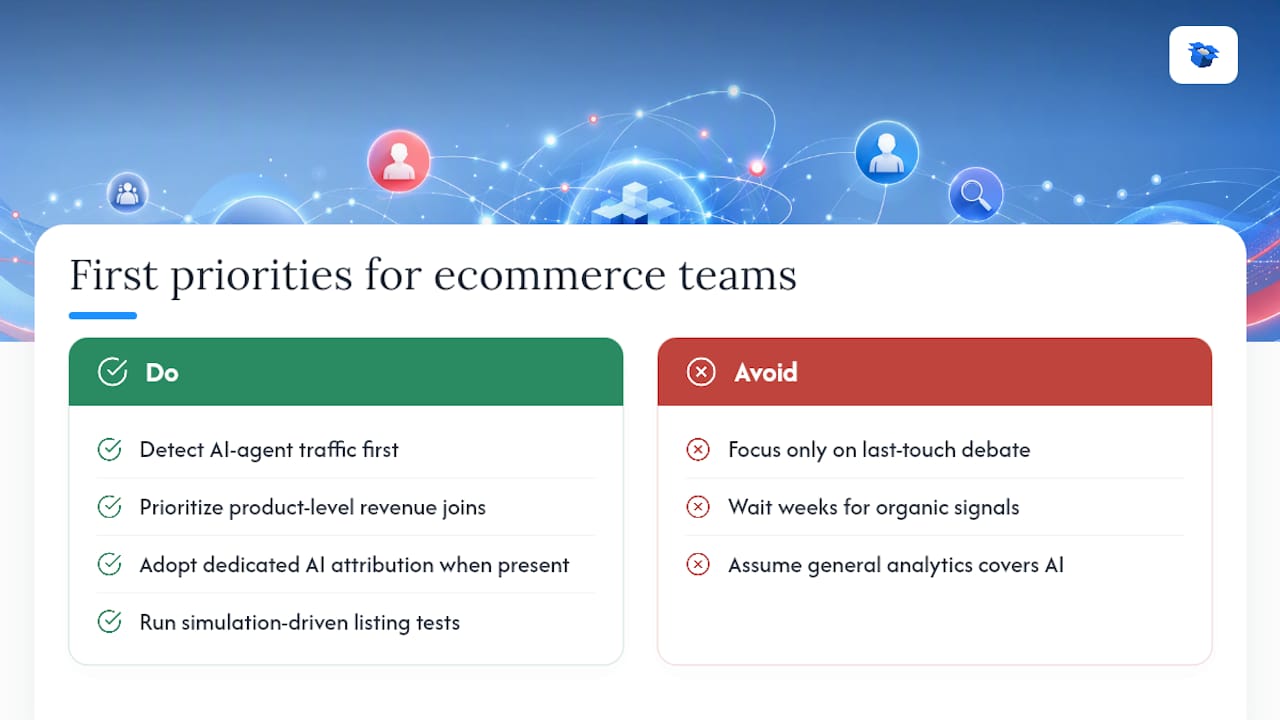
The attribution conversation has been stuck on last-touch versus multi-touch for years, and that debate is quietly becoming outdated. The more urgent question for ecommerce teams right now is whether their stack can see AI-agent-driven traffic at all. Most can’t yet, which means real revenue is getting misattributed to “direct” or vanishing from reports entirely.

What Ecommerce Teams Should Prioritize First — overview diagram

Product-level joins deserve more attention than they get. Attributing revenue to a campaign is useful. Attributing it to the exact product page and listing content that convinced a shopper, or an AI agent recommending on a shopper’s behalf, is what actually tells you what to fix next. That’s a fundamentally different question than most multi-touch models were built to answer.

A dedicated ecommerce AI-attribution approach makes sense once you’re seeing measurable traffic from ChatGPT, Gemini, or Perplexity and can’t yet explain how those visits convert. A general analytics stack still works fine for teams whose funnel is dominated by traditional paid and organic channels with no meaningful AI-agent signal yet. Simulation-driven workflows, testing how an AI agent actually evaluates a product listing before that listing goes live, tend to shorten the feedback loop dramatically compared to waiting weeks for organic traffic patterns to reveal the same insight.

— Xhurian

08

Where Ecentic Fits Into Your Attribution Stack

Where Ecentic Fits Into Your Attribution Stack

Ecentic is built specifically for the gap most attribution tools miss: how AI shopping agents like ChatGPT, Gemini, Claude, and Perplexity actually evaluate and recommend your product listings. It connects directly to Shopify and WooCommerce, runs simulation-driven diagnostics on your product pages, and gives plain-English feedback on why an AI agent would or wouldn’t recommend a specific listing.

Ecentic

If your team is a DTC or ecommerce brand trying to prove ROI from AI-driven discovery, not just paid and organic channels, agent traffic analytics and product-level revenue attribution fill a blind spot most general attribution stacks weren’t built to see. Some businesses using similar platforms have reported measurable increases in AI-driven visits and sales after acting on optimization recommendations.

A practical next step: request the free introductory scan on your current product listings, then test specific pages in the UCP Playground to see exactly how an AI agent scores them against competitors. During a trial, ask for agent-driven visit counts, conversion rate on that traffic, and before-and-after selection rates once you’ve applied the optimization recommendations.

09

Sources

Sources

  • The 17 best AI marketing tools in 2026 | Canto
  • 10 Best Marketing Attribution Tools & Platforms (2026)
  • I tested the 10 best attribution software: hits and misses | G2 Learn
  • AI Citation Tracker — Attrifast features
10

FAQ

FAQ

Which AI Tool Is Best for Content Creators Optimizing for AI Visibility?

Content creators focused on ecommerce product pages benefit most from tools that simulate how AI shopping agents evaluate listing content, since generic SEO tools don’t model agent-specific ranking factors. A platform purpose-built for product-listing optimization fits that need directly.

What Is the Best Attribution Model for Ecommerce?

There’s no single best model. Multi-touch models work well for understanding channel mix, but product-level revenue joins combined with server-side, first-party event capture give ecommerce teams the clearest read on which listings and channels actually drive sales.

What Is the Best B2B Attribution Software?

B2B attribution generally favors enterprise multi-touch platforms with strong CRM integration, since B2B sales cycles involve multiple stakeholders and longer pipelines than typical ecommerce purchases. Fixing account-level data quality upstream matters more than the specific model chosen.

Which AI Is Best for Promoting Products to AI Shopping Agents?

The tools built specifically for AI shopping agent visibility, ones that simulate ChatGPT, Gemini, Claude, and Perplexity behavior against your actual product pages, are best suited for this, since general marketing AI tools aren’t designed to diagnose agent-specific recommendation factors.

AI tools for performance trackingAI-driven attribution platformsAI analytics tools for marketingtop AI marketing toolsAI attribution softwarebest marketing attribution solutionsautomated marketing attributionleading attribution tools 2023best multi-touch attribution toolsbest ai attribution toolshow to choose attribution tools
Back to blogGet started

Guides and research on winning AI shopping agents.

Get picked by AI

Ready to be the product agents recommend?

Install free on Shopify or WooCommerce and see your AI score in minutes.

Install on ShopifyInstall on WooCommerce
ecentic

Win every AI shopping agent's cart.

Built for the agent economy
Product
  • Features
  • How it works
  • Pricing
  • Product Listings
Platforms
  • Shopify
  • WooCommerce
  • Enterprise
Resources
  • Developer docs
  • API reference
  • Resources
  • Blog
  • Compare
  • UCP Validator
  • UCP Playground
  • Book a demo
Company
  • Support
  • Privacy policy
  • Terms of service

© 2026 ecentic. All rights reserved.

Made for merchants who refuse to be invisible to AI.