
ecenticecentic
How it worksResourcesPricingBlog
Install now
ASCII-art illustration of a stack of books

Best AI Agent Simulators for Testing Product Page Visibility

Published: August 21, 2026 · 18 min read

Discover the best AI agent simulators to enhance your product page visibility. Run a free audit and optimize your sales performance now!

00

Key Takeaways

Decorative title card illustration for AI agent simulators

Run a simulation-driven readiness audit paired with cross-engine win-rate testing. That combination catches what generic SEO checklists miss: the machine-readable signals that ChatGPT, Gemini, Claude, and Perplexity actually use to decide which products to recommend. Ecentic packages this approach for Shopify and WooCommerce merchants, and it’s the platform we’d point you to first because it fixes the same signals it measures.

Here’s why this matters right now:

  • Agents skip pages where price and availability only render after JavaScript loads
  • A readiness auditor like CatalogReady scores your page 0 to 100 and tells you exactly what’s broken
  • The fastest path to a diagnosis is a free scan, not a guess

Run one audit today. Everything below explains what it measures and why.

Key Takeaways

Winning AI shopping-agent recommendations depends on machine-readable coherence across your page, feed, and schema more than on persuasive product copy.

Point Details
Fix structure before copy Server-render price and availability, and complete your Product and Offer JSON-LD before rewriting descriptions.
Check crawler access Confirm robots.txt and llms.txt allow OAI-SearchBot, PerplexityBot, and similar agent crawlers.
Reconcile every surface Cross-check price and availability across your page, feed, and schema; mismatches disqualify products.
Test across engines Run identical queries on ChatGPT, Perplexity, and Gemini before and after fixes to confirm real wins, not just score gains.
Use Ecentic for ongoing diagnostics Ecentic runs deterministic readiness audits, supplies paste-ready JSON-LD fixes, and tracks agent-driven visits for Shopify and WooCommerce stores.
01

What Are AI Agent Simulators and Why Do Merchants Need Them?

What Are AI Agent Simulators and Why Do Merchants Need Them?

An AI shopping-agent simulator recreates the exact process ChatGPT, Gemini, or Perplexity uses to evaluate your product page, then reports what the agent saw, what it ignored, and why it picked a competitor instead. This is a different tool category from general-purpose agent testing frameworks built for engineers debugging multi-agent workflows. Shopping-agent simulators exist for one job: telling merchants whether their listings survive contact with an AI buyer.

That contact happens in three stages, according to analysis of agentic commerce protocols. First, retrieval: can the agent’s crawler even fetch your page and parse structured data from it? Second, trust: do your reviews, policies, and price claims line up across every surface the agent checks? Third, action: can the agent confirm inventory and complete a purchase path without hitting a dead end? A product that fails any one layer gets dropped from consideration, regardless of how good the copy reads to a human.

A simulator can measure whether your JSON-LD parses, whether your price matches your feed, and whether a specific query surfaces your product in a specific engine on a specific day. It cannot promise a permanent top ranking. Agent outputs shift with model updates, competitor changes, and query phrasing, so treat every simulation as a snapshot, not a guarantee.

02

How Do You Evaluate an AI Agent Simulator?

How Do You Evaluate an AI Agent Simulator?

Not every tool marketed as an AI simulation app actually tests what matters to a shopping agent. Before you trust a readiness score, check that the tool covers these five areas.

  1. Schema and server-rendered data validation. The tool should check your Product and Offer JSON-LD for title, GTIN or SKU, price, currency, and availability, and confirm those fields render in static HTML rather than only after JavaScript executes. AgentMint’s analysis of product page anatomy notes that many AI crawlers fetch static HTML only, so client-side-only data is invisible to them.
  2. Crawler access checks. It should read your robots.txt and llms.txt files and confirm specific bots like OAI-SearchBot and PerplexityBot aren’t blocked.
  3. Claim coherence across surfaces. A trustworthy auditor cross-checks the price and availability on your page against your product feed and your schema markup, flagging mismatches that get products disqualified outright.
  4. Deterministic diagnostics. Look for rule IDs and paste-ready JSON-LD patches rather than vague “improve your SEO” advice. CatalogReady, an open-source auditor, scores pages 0 to 100 and ties every flaw to a specific, fixable rule.
  5. Multi-engine simulation with attribution. A single-engine test tells you how ChatGPT sees your page, but says nothing about Gemini or Perplexity, which weight freshness and citations differently.

Pro Tip: Ask any vendor whether their readiness score is deterministic (rule-based, reproducible) or a model-generated estimate. Deterministic scores let you reproduce the same result tomorrow; model-generated ones can drift between runs for reasons that have nothing to do with your page.

03

How Do You Run a Win-Rate Test on Your Product Pages?

How Do You Run a Win-Rate Test on Your Product Pages?

This protocol takes under a day and gives you a before-and-after comparison you can act on immediately.

  1. Fetch your page without JavaScript. Pull the raw HTML and confirm your title, price, availability, and identifiers appear in the static response, not just the rendered DOM.
  2. Validate your Product and Offer JSON-LD. Check that priceCurrency, price, availability, and GTIN or SKU are present and match what a shopper sees on the page.
  3. Check robots.txt and llms.txt. Confirm you’re not blocking the crawlers agents rely on, and add an llms.txt file if you haven’t already; StoreSEO’s analysis treats this as one of the highest-leverage technical fixes available to Shopify merchants.
  4. Run a deterministic auditor and export the findings. Get your rule IDs and paste-ready fixes, then apply the server-rendering and schema patches directly.
  5. Query the same product across ChatGPT, Perplexity, and Gemini before and after your fixes. Log whether the agent recommends your product, ignores it, or picks a competitor.
  6. Track the readiness score delta alongside agent-driven visits. Score movement is a leading indicator; actual visits and conversions from agent traffic are the real test.
Metric What to Log
Readiness score 0 to 100 score before and after fixes, plus which rule IDs cleared
Wins per engine Whether ChatGPT, Perplexity, and Gemini recommended the product on identical queries
Agent-driven visits Sessions attributed to agent referral traffic, tracked weekly
Conversions Orders completed from agent-attributed sessions

Practitioner guidance on this kind of testing is consistent on one point: readiness score movement alone doesn’t prove anything. The honest test is whether an agent’s actual recommendation changes on the same query before and after your fixes.

Pro Tip: Run your before/after queries at the same time of day and with identical phrasing. Agent responses can vary by session even without any changes on your end, so a single query pair proves nothing. Run each query three times per engine and take the majority result.

04

What Belongs on Your Agent-Readiness Checklist?

What Belongs on Your Agent-Readiness Checklist?

Run through this list on any product page before you touch anything else. It’s ordered by how often each item blocks an agent recommendation, not by how easy each fix is.

  • Product name, brand, and identifiers (GTIN, MPN, or SKU) present in both HTML and JSON-LD
  • All-in price and currency rendered server-side, matching your feed exactly
  • Availability status current and consistent across page, schema, and feed
  • At least one product image referenced in your schema, not just displayed visually
  • Review count and rating exposed in structured data, not buried in a third-party widget

The six fixes that unblock the most agents, in rough order of frequency: server-render your price and availability instead of loading them via JavaScript, paste in complete Product and Offer JSON-LD, reconcile your feed against your live page pricing, link your shipping and return policies from the product page itself, add a short FAQ block addressing common buyer questions, and give the agent comparison context (materials, sizing, what makes this variant different from a similar one). Triage by impact versus effort: schema and server-rendering fixes take an afternoon and unblock retrieval entirely, while comparison context takes longer to write but rarely determines whether an agent finds you at all.

05

Comparing the Top AI Agent Simulators on Price and Depth

Comparing the Top AI Agent Simulators on Price and Depth

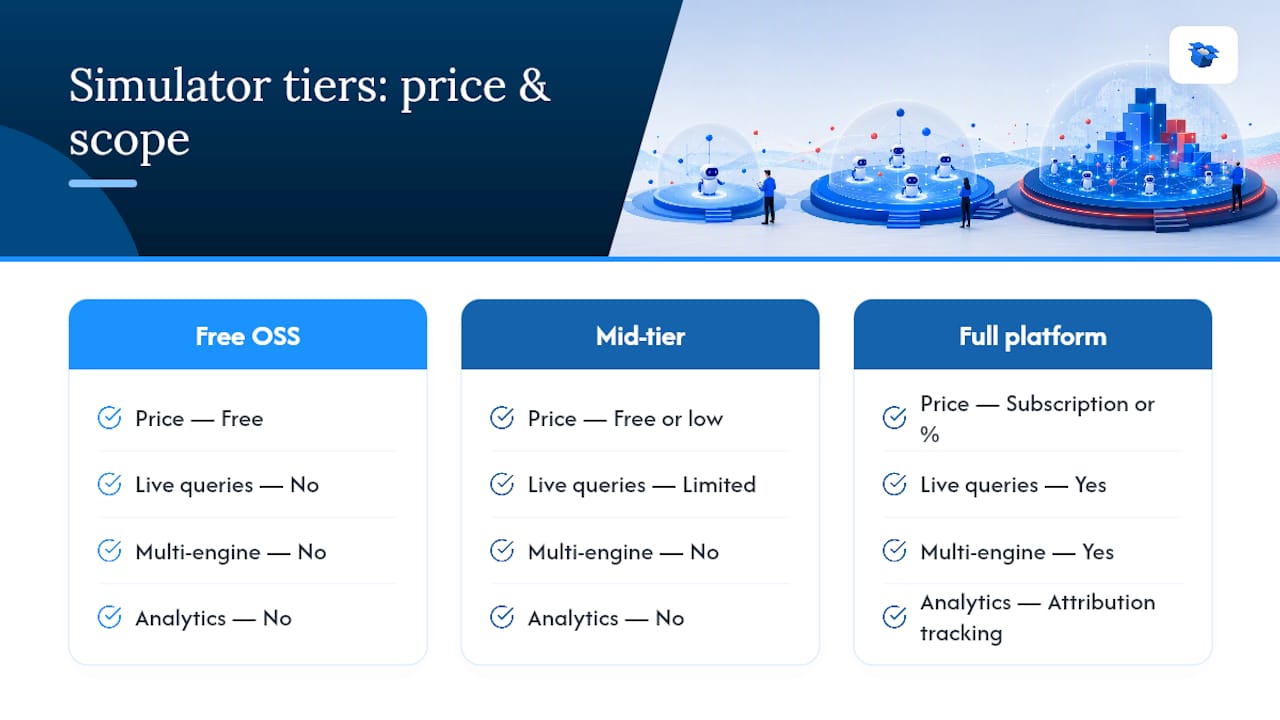
Diagram comparing AI agent simulators by price and depth

Simulator tools split into three tiers. Free, open-source auditors like CatalogReady give you a deterministic 0 to 100 score, rule IDs, and JSON-LD patches, running entirely offline with no API key required. That makes them a strong first move: no cost, no signup friction, and output you can act on the same day. The tradeoff is scope. A local auditor checks your schema and server-rendering, but it won’t run live queries against ChatGPT or Perplexity to show you what an agent actually recommends today.

Mid-tier checkers, often free or low-cost web tools, run a single-page scan and flag obvious blockers like missing schema fields or blocked crawlers. They’re useful for a quick sanity check but usually stop short of cross-engine testing or ongoing monitoring.

Full platforms, where Ecentic sits, combine the deterministic auditing of an open-source tool with live multi-engine simulation, attribution analytics tracking actual agent-driven visits, and one-click publishing of fixes into Shopify or WooCommerce. Pricing here runs as either a flat monthly subscription or a percentage of orders attributable to agent traffic, with a free scan as the entry point. The gap between tiers isn’t really about accuracy on any single check. It’s about whether you’re testing one page manually or running continuous diagnostics across a catalog while tracking whether agent traffic actually converts.

06

Does the Tool’s Interface Make the Data Usable?

Does the Tool’s Interface Make the Data Usable?

A readiness score means nothing if you can’t translate it into a fix before your next product launch. The best simulators present results as a prioritized list, worst offender first, with plain-English explanations next to each rule ID rather than a wall of technical output.

Open-source command-line auditors like CatalogReady require comfort with a terminal and reading JSON output directly, which works fine for a technical team member but creates friction for a solo DTC merchant managing their own storefront. Web-based platforms trade some of that raw control for a dashboard: a readiness score front and center, a list of failed checks below it, and a button or code snippet to apply the fix rather than a manual patch you copy into your theme files.

Two interface details separate a genuinely useful tool from one that just looks polished. First, does it show you why a check failed, with the specific field or line of markup involved, or just that it failed? Second, can you re-run the same check after a fix without starting the whole audit over? A tool that forces a full rescan for every small edit turns a five-minute fix into a twenty-minute cycle, and most merchants stop bothering after the third round. Platforms built for ongoing use, rather than a one-time audit, tend to separate “rescan everything” from “recheck this one rule,” which matters more than it sounds once you’re managing more than a handful of SKUs.

07

How Realistic Are These Simulations Compared to Real Agent Behavior?

How Realistic Are These Simulations Compared to Real Agent Behavior?

The honest answer: realistic enough to catch structural blockers, imperfect at predicting exact rankings. A simulator that checks your schema, crawler access, and price coherence is testing the same mechanical gates a real agent hits. If your JSON-LD is missing a required field or your robots.txt blocks PerplexityBot, that failure is deterministic. It will reproduce the same way every time, in a simulation or in production.

Where simulation gets fuzzier is the final recommendation step. Agents weigh freshness, phrasing of the shopper’s query, and competitive context in ways that shift between sessions and model updates. A query that surfaces your product today might not tomorrow, even with no changes on your end. That’s why a single win/loss test proves little. Running the same query three times per engine and tracking the majority outcome, as outlined earlier, gives you a more honest read than a one-shot check.

Multi-engine testing also matters because ChatGPT, Gemini, and Perplexity don’t behave identically. Perplexity in particular favors fresh, citable content and rewards clear attribution, according to research on agent-facing credibility signals, which found that adding citations, quotations, and statistics to a page can lift its visibility in generative answers by up to 40%. A simulator that only tests against one engine will miss that gap entirely, and you’ll optimize for the wrong signals without realizing it.

08

What Should You Expect From Support and Documentation?

What Should You Expect From Support and Documentation?

Open-source tools like CatalogReady come with a GitHub readme and whatever community activity surrounds the project. That’s fine if you’re comfortable reading rule definitions in code and debugging JSON-LD errors yourself, but it leaves you without anyone to ask when a fix doesn’t behave the way you expected.

Commercial platforms vary widely here, and the difference shows up fastest when a fix doesn’t take. Good documentation for this category means more than a features page. It means a specific explanation of what each rule ID checks, an example of the JSON-LD before and after a fix, and a support channel that understands agent behavior specifically rather than general ecommerce SEO. A support team that can explain why PerplexityBot behaves differently from OAI-SearchBot is worth more than one that just walks you through a generic ticketing script.

Ask about update cadence before committing to any platform. Agent behavior shifts when providers update their models, and a tool with documentation that hasn’t kept pace with the current version of ChatGPT Shopping or Gemini’s product search is testing against a moving target with an outdated map. The structured data checklist approach, keeping implementation guidance current with schema.org changes, matters more here than in most software categories because the underlying agents change faster than typical SEO guidance does.

09

What Do Real Fixes Look Like in Practice?

What Do Real Fixes Look Like in Practice?

The pattern that shows up across successful fixes is almost always the same: a page that looked complete to a human shopper was quietly invisible to an agent because of one specific, fixable gap. A price that only rendered after a JavaScript call. A feed that listed a product as in stock while the page’s schema said otherwise. A missing GTIN that made price comparison across retailers impossible for the agent to complete.

Hands verifying product data in audit

Merchants who ran a deterministic audit first, rather than guessing at SEO-style fixes, consistently found the actual blocker was structural, not content-related. Rewriting product descriptions rarely fixes a crawler access problem. Reconciling your feed against your live page pricing does. Ecentic customers have reported measurable increases in both AI-driven visits and overall sales after running this kind of audit and applying the resulting fixes, which tracks with the broader pattern: fix the machine-readable layer first, and the recommendation-rate improvements tend to follow because the agent can finally read what you’re offering.

The lesson generalizes past any single case: cross-surface disagreement between your page, your feed, and your schema is a bigger disqualifier than weak copy. Merchants chasing keyword-level content changes before fixing that mismatch are optimizing the wrong layer.

10

What Actually Moves the Needle Here?

What Actually Moves the Needle Here?

Most advice on AI shopping visibility still treats it like traditional SEO with a new acronym slapped on. It isn’t. Traditional SEO rewards relevance signals accumulated over months. Agent visibility rewards structural correctness you can fix this afternoon: does your JSON-LD parse, does your price match your feed, can the crawler even reach the page. That’s a fundamentally different problem, and most merchants are still solving the wrong one.

The overlooked piece is coherence, not content. A page can have excellent copy and still lose to a competitor because the price in the feed doesn’t match the price on the page. Agents treat that mismatch as a trust failure and move on. No amount of persuasive writing fixes a structural disagreement between your own data sources.

If you do one thing first, run a deterministic audit before you touch a word of copy. Fix what the audit flags as broken, reconcile your feed, then test the same query across multiple engines to see whether the fix actually changed the outcome. Skip the win-rate test and you’re optimizing on faith. The UCP Playground exists specifically because a readiness score alone doesn’t tell you if an agent’s actual recommendation changed, and that gap between “score improved” and “agent picked me” is where most merchants stop looking too soon.

11

Turn Your Readiness Score Into Actual Agent Traffic

Turn Your Readiness Score Into Actual Agent Traffic

Running your own audit tells you what’s broken. Fixing it across a full catalog, then proving the fix worked, is where most merchants run out of time. Ecentic closes that loop: it connects directly to Shopify or WooCommerce, runs the same deterministic diagnostics covered above across your entire catalog, and gives you paste-ready JSON-LD patches with rule IDs instead of vague suggestions.

Ecentic

Beyond the audit, Ecentic’s UCP Playground lets you simulate how ChatGPT, Gemini, Claude, and Perplexity evaluate any live product page and test changes before you commit them. One-click publishing pushes fixes straight into your store, and attribution analytics track agent-driven visits and orders so you can see whether a fix actually changed your win rate, not just your readiness score. Customers have reported measurable increases in both AI-driven visits and sales after running this workflow.

If your store runs on Shopify, the platform-specific setup connects in minutes; WooCommerce merchants get the same integration path. Start with a free scan of your product listings to see your current readiness score before deciding what to fix first.

12

Sources

Sources

For hands-on testing beyond this article, CatalogReady offers a free, offline 0 to 100 readiness auditor with paste-ready fixes. CrawlConsole’s product page checklist walks through the exact fields agents check. For broader context on AI’s role in ecommerce, BabyLoveGrowth’s roundup of AI use cases is a useful starting point.

  • CatalogReady (ai-shopping-audit) — GitHub
  • How AI Agents Find and Read Your Products | ACP Info
  • Agentmint
  • How ChatGPT, Gemini & Perplexity Recommend Shopify Products – StoreSEO
13

FAQ

FAQ

What Is an AI Shopping-Agent Simulator?

It’s a tool that recreates how ChatGPT, Gemini, or Perplexity read and evaluate a product page, showing you what the agent sees, ignores, and why it may pick a competitor instead.

Are Free AI Agent Simulators Good Enough for Small Stores?

Open-source auditors like CatalogReady work well for a single-page check and cost nothing, but they don’t run live multi-engine queries or track ongoing agent traffic the way a full platform does.

How Often Should I Re-Run a Readiness Audit?

Re-run your audit after any pricing, inventory, or schema change, and at minimum monthly, since agent behavior shifts as ChatGPT, Gemini, and Perplexity update their models.

Can a Simulator Guarantee My Product Gets Recommended?

No tool can guarantee a permanent ranking; agent recommendations shift with query phrasing and model updates, so treat any simulation as a snapshot rather than a lasting promise.

Does Ecentic Work With Both Shopify and WooCommerce?

Yes, Ecentic connects directly to both Shopify and WooCommerce stores and applies fixes through one-click publishing after an audit.

best AI training simulatorsbest practices for AI simulationshow to create AI agentsAI simulation gamestop AI simulation toolsAI agent simulation softwareaffordable AI agent simulatorsbest ai agent simulatorspopular AI simulation appsrealistic AI agent simulatorsai agent testing toolsAI agent scenario simulationsAI agent development platforms
Back to blogGet started

Guides and research on winning AI shopping agents.

Get picked by AI

Ready to be the product agents recommend?

Install free on Shopify or WooCommerce and see your AI score in minutes.

Install on ShopifyInstall on WooCommerce
ecentic

Win every AI shopping agent's cart.

Built for the agent economy
Product
  • Features
  • How it works
  • Pricing
  • Product Listings
Platforms
  • Shopify
  • WooCommerce
  • Enterprise
Resources
  • Developer docs
  • API reference
  • Resources
  • Blog
  • Compare
  • UCP Validator
  • UCP Playground
  • Book a demo
Company
  • Support
  • Privacy policy
  • Terms of service

© 2026 ecentic. All rights reserved.

Made for merchants who refuse to be invisible to AI.