ecentic
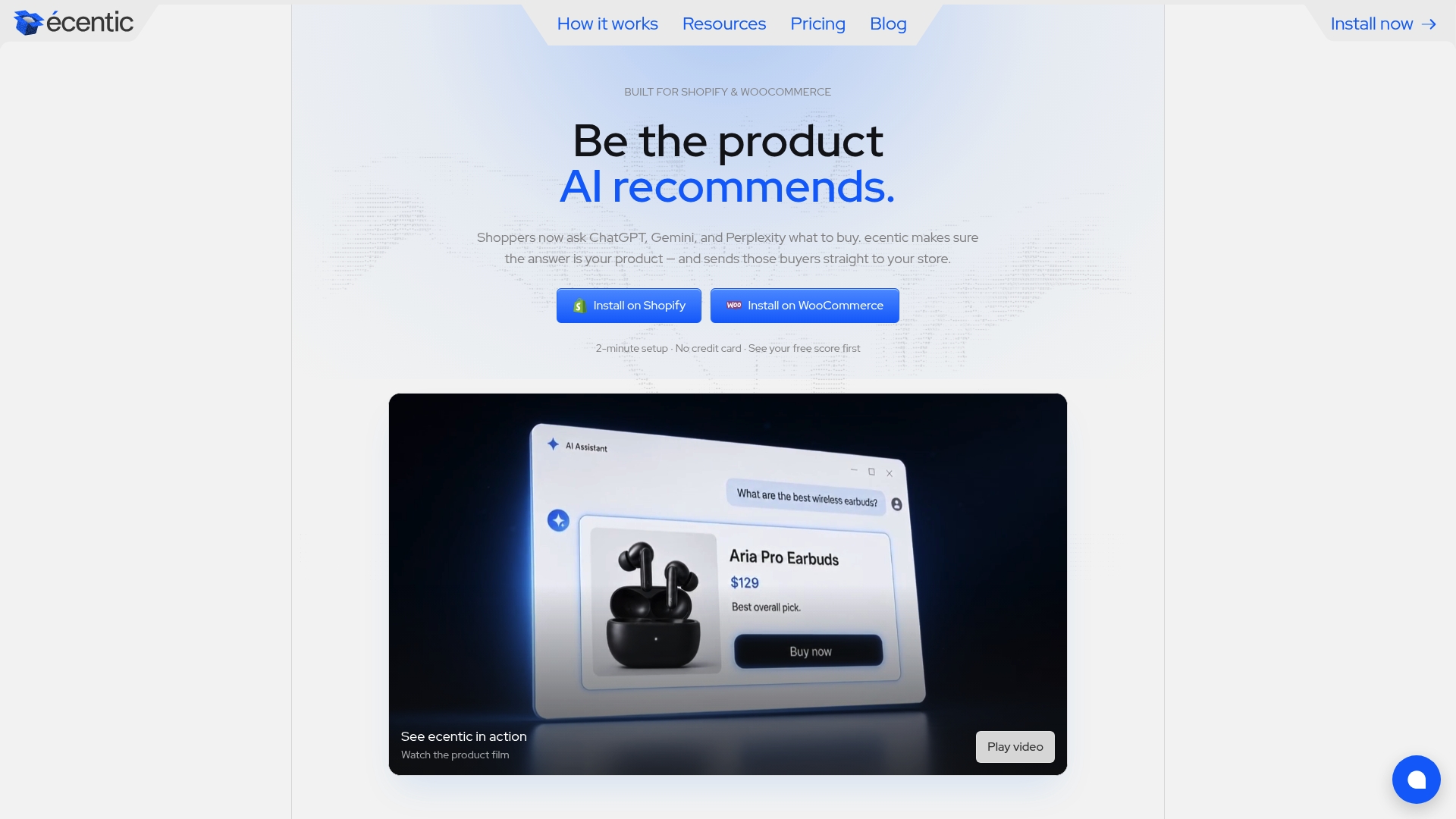
ecentic is built around a simulation engine that mimics how AI shopping agents actually evaluate a product page, then hands you the specific rewrite suggestions that move the needle. Connect a Shopify or WooCommerce store, and it runs continuous rescans to track your AI selection rate over time rather than giving you a one-time snapshot.
- Best for: ecommerce brands and DTC merchants who need their product listings recommended by ChatGPT, Gemini, Claude, and Perplexity shopping agents, not just mentioned in passing.
- Standout features: simulation-driven diagnostics that show win/loss reasoning in plain English, one-click publishing of fixes to Shopify and WooCommerce, a UCP Playground for testing agent behavior against your live store, and agent-traffic attribution analytics.
- Integrations: native Shopify and WooCommerce connections, with UCP profile generation and validation built in.
- Pricing: a free introductory scan, then monthly subscription tiers or a pay-as-you-go model tied to the percentage of orders attributable to agent-driven traffic.
- Pros: purpose-built for the product-recommendation use case that generic trackers ignore; the one-click publish workflow removes the usual gap between diagnosis and fix.
- Cons: narrower scope than an enterprise multi-brand governance platform, since the focus stays on ecommerce listings rather than broad brand mentions across every content type.
Profound
Profound targets enterprise teams that need to monitor AI visibility across many brand properties at once. It’s built around proprietary prompt volumes and dashboards designed for executive reporting rather than day-to-day content fixes.
- Best for: large brands needing multi-engine governance and board-level visibility reporting.
- Standout features: proprietary prompt-volume data and executive dashboards.
- Cons: enterprise pricing and complexity are overkill for a single-brand or ecommerce use case.
Scrunch AI
Scrunch AI leans into enterprise governance with named AI-crawler analytics, which tells you specifically which crawler (GPTBot, ClaudeBot, and similar) touched your content and when.
- Best for: large organizations that need crawler-level analytics alongside visibility governance.
- Standout feature: named AI-crawler analytics baked into an enterprise control layer.
Geoptie
Geoptie is built for agencies. Its white-label reporting and workspace structure let a single account manager track AI visibility across dozens of client brands without juggling separate logins.
- Best for: agencies managing multiple brands under one roof.
- Standout feature: white-label reporting paired with built-in content recommendations, so an agency can hand a branded report straight to a client.
AirOps
AirOps takes the “monitor plus execute” archetype seriously. Rather than stopping at a dashboard, it closes the loop between an insight and a content automation playbook, which matters if your team is small and can’t afford a separate content-ops tool bolted on afterward.
- Best for: teams that want visibility monitoring and content execution in a single system.
- Standout feature: automation playbooks tied directly to visibility insights.
Peec AI
Peec AI keeps things simple: daily prompt-based tracking across engines at a price point that doesn’t require a procurement committee. Unlimited seats mean an entire marketing team can watch the same dashboard without per-seat fees stacking up.
- Best for: small teams and agencies that need low-friction daily tracking without enterprise pricing.
- Standout feature: unlimited seats at a lower starting price than most enterprise-tier competitors.
Ahrefs Brand Radar
If your team already lives inside Ahrefs for traditional SEO, Brand Radar adds AI visibility on top of a prompt database built from real search queries, not synthetic guesses at what people ask AI engines.
- Best for: teams already running SEO through Ahrefs who want AI visibility without switching platforms.
- Standout feature: a large real-search prompt index that shows what people are actually asking.
Semrush folds AI visibility into its existing toolkit, with Copilot-style recommendations layered onto workflows teams already use for keyword research and technical audits.
- Best for: brands already running SEO on Semrush who want AI visibility added without a new vendor relationship.
- Standout feature: Copilot recommendations integrated into existing Semrush workflows.
Otterly AI
Otterly AI is the budget pick for teams that need multi-engine coverage without the enterprise price tag, including high-volume GEO and URL audits for teams managing large content libraries.
- Best for: budget-conscious teams wanting an entry-level tracker.
- Standout feature: high-volume audits at a notably lower starting price than category leaders.
HubSpot AEO
HubSpot’s AEO features live inside the CRM and content tools marketers already use daily, which shortens the distance between an AI visibility gap and a fix inside a blog post or landing page.
- Best for: HubSpot users who want AI visibility monitoring inside their existing content and CRM workflow.
Writesonic, Surfer AI Tracker, and Nightwatch each bring AI visibility tracking bolted onto content generation or rank-tracking tools many teams already own, useful if you’d rather add a module than adopt a new platform. Goodie AI, AthenaHQ, and BrightEdge target enterprise content and SEO teams with broader reporting suites. Airefs, SE Ranking AI Search, and SE Visible offer more affordable multi-engine tracking aimed at agencies and mid-market teams. AIclicks publishes its own comparison of AEO tracking platforms worth a look if you want a second opinion on scoring methodology. Cognizo, Qwairy, Gauge, Rank Prompt, ProductRank.ai, Gumshoe, AI SEO Tracker, AEO Vision, Rankscale AI, and Analyze AI round out a growing field of specialized trackers, most differentiated by niche prompt sets or industry focus rather than category-defining features. Conductor and Meltwater GenAI Lens extend established enterprise content and PR platforms into AI visibility monitoring, a natural fit for teams that already report through those systems.
Pro Tip: Nuwtonic’s category mapping splits this market into monitoring, analysis, and optimization tools. Most teams end up pairing one tracker with one optimizer rather than expecting a single platform to do both jobs well, unless they specifically choose an all-in-one like AirOps or ecentic.


 Install on Shopify
 Install on WooCommerce