ecenticecentic
How it worksResourcesPricingBlog
Install now
ASCII-art illustration of a stack of books

Shopify Generative SEO: A GEO Playbook for Merchants

Published: August 20, 2026 · 21 min read

Unlock the potential of Shopify Generative SEO to boost your store's visibility. Learn to optimize for AI shopping agents today!

00

Key Takeaways

Decorative title card illustration

Shopify generative SEO (GEO) is the set of content, data, and platform changes that make your product and collection pages quotable and recommendable by AI shopping agents. When ChatGPT, Gemini, or Perplexity answer a shopping question, they pull specific facts from specific pages, not vague brand copy, and reward the merchants who made those facts easy to lift.

Three moves matter more than everything else combined right now. First, write a one to two sentence answer-first summary on every product page that states what it is, who it’s for, and one measurable fact. Second, complete your structured product data through metafields and schema markup so agents can trust the numbers. Third, add a per-product FAQ block with FAQ schema, since agents pull specific answers, not marketing paragraphs.

The urgency is real. Shopify’s Q1 2026 data shows AI-referred sessions grew more than 8x year-over-year, with AI-referred orders up nearly 13x, and those AI-driven shoppers convert nearly 50% better than organic search traffic.

  • Rewrite one flagship product’s opening sentence to be quotable, not clever.
  • Fill three missing metafields (dimensions, materials, warranty) this week.
  • Publish FAQ schema on your five highest-traffic products before month’s end.

Ecentic’s simulation tools show exactly which of these gaps is costing you AI recommendations right now.

Key Takeaways

Shopify generative SEO succeeds when merchants fix structured product data first, write answer-first quotable copy second, and measure AI citations continuously rather than once.

Point Details
Lead with an answer Open every product page with a one to two sentence, fact-specific summary an agent can quote directly.
Data before copy Complete metafields for specs, materials, and dimensions before rewriting marketing descriptions.
Schema on every FAQ Add per-product FAQ blocks with FAQ schema sourced from metafields for updatability.
Track AI-specific KPIs Filter Shopify Analytics for AI referrers and monitor citation rates monthly through prompt testing.
Diagnose before rewriting Ecentic’s simulation diagnostics show which specific listing gaps stop ChatGPT and Gemini from recommending a product.
01

What Is Generative SEO and How Does It Differ From Traditional SEO?

What Is Generative SEO and How Does It Differ From Traditional SEO?

Generative Engine Optimization is the practice of shaping content so AI systems can extract, trust, and repeat it as a standalone answer. Traditional SEO optimizes for rankings on a results page; GEO optimizes for the “quotable fact,” the self-contained sentence an AI model can lift out of context and still have it make sense. AI answer engines don’t just crawl a page and index it — they run query fan-out, spinning a single shopper question into a dozen related sub-queries and synthesizing answers from whichever pages answer each piece cleanly.

That changes what “winning” looks like:

  • Winning unit: Traditional SEO rewards a page that ranks. GEO rewards a sentence or data point that gets cited, sometimes from deep inside a page nobody would click through to directly.
  • Signals that matter: SEO leans on backlinks and keyword density. GEO leans on structured data, factual density, and answer clarity.
  • Success metric: SEO tracks rank position. GEO tracks citation frequency and AI-referred revenue.

A generic line like “Our jackets combine style and comfort” is unquotable filler. “This jacket uses 600-fill goose down and weighs 14 ounces in a men’s medium” is exactly the kind of sentence an agent will repeat verbatim to a shopper asking about warm, lightweight winter coats.

02

Why Should Shopify Merchants Prioritize GEO Now?

Why Should Shopify Merchants Prioritize GEO Now?

The numbers already cited aren’t a future prediction, they’re a current shift in where buying traffic originates. AI-referred visitors converting at nearly 50% higher rates than organic search visitors means these aren’t casual browsers. They arrive after an agent has already vetted the product against a question, so they’re closer to a purchase decision the moment they land.

By the numbers: AI-referred sessions on Shopify grew over 8x year-over-year, AI-referred orders nearly 13x, and conversion rates for that traffic ran almost 50% above organic search.

Shopify merchants also have structural advantages competitors on custom-built stacks don’t. Shopify’s platform supports server-side rendering out of the box, which matters because most AI crawlers can’t reliably execute client-side JavaScript. Shopify Catalog keeps variant and inventory data centralized rather than scattered across a homegrown database, and features tied to Agentic Storefronts and the Universal Commerce Protocol (UCP) are being developed specifically so AI agents can transact against a store’s data directly, not just read it.

  • Server-side rendering means your specs are visible to crawlers without extra work.
  • Shopify Search & Discovery already structures product relationships an agent can reuse.
  • Shopify’s own generative recommender research shows that consistent, well-modeled product data measurably improves recommendation outcomes at scale.

A mid-sized apparel merchant that fixes even a handful of missing metafields and rewrites five product summaries can see AI referral traffic move within weeks, since agents rescan popular product feeds far more often than search engines recrawl a static site.

03

What Are the Best GEO Strategies for Product Pages?

What Are the Best GEO Strategies for Product Pages?

Every tactic below exists to answer one question: can an AI agent lift a fact from this page and repeat it confidently? Here’s the priority order.

  1. Write an answer-first summary. The first sentence on every product page should state the product’s purpose, its intended buyer, and one specific measurable fact, all in a single breath. Skip adjectives; agents don’t quote adjectives, they quote numbers and specs.
  2. Expand the page body with quotable detail. Add exact measurements, material composition, use cases, review counts, and release dates as short, independent sentences rather than one long marketing paragraph. Each sentence should survive being copied out of context and still make sense.
  3. Build per-product FAQs with schema. Three to five questions per product, answered in one or two sentences each, wrapped in FAQ schema markup. “Does this fit over a hoodie?” answered plainly beats a five-paragraph sizing guide an agent has to interpret.
  4. Use metafields to hold structured attributes. Store dimensions, care instructions, certifications, and compatibility data in metafields, then surface those same values inside your schema markup and page templates so the number only has to be correct in one place.
  5. Structure content with a clear heading hierarchy. Use H2s and H3s for distinct product attributes, keep paragraphs short, and use bullet points for specs, but never let bullets replace the answer-first sentence at the top.

Pro Tip: Read your product page’s opening sentence out loud as if you were an AI agent answering a shopper’s question. If it doesn’t sound like a complete, standalone answer, rewrite it before touching anything else on the page.

The structured data checklist for ecommerce product pages is worth working through line by line here, since missing a single required schema property can quietly disqualify a page from citation even when the copy itself is strong.

Hands auditing ecommerce product data checklist

04

What Technical Fixes Make Shopify Pages AI-Ready?

What Technical Fixes Make Shopify Pages AI-Ready?

Great copy sitting on broken technical foundations still won’t get cited. Search Engine Land’s Shopify readiness analysis found that structured data gaps, thin internal linking, incomplete product pages, and slow performance are the most common reasons Shopify sites leak value before GEO-specific work even starts.

Work through these in order:

  • Implement Product, Review, and FAQ schema, and source every value from a metafield rather than hardcoding it into a theme file.
  • Model variants correctly as parent and child products in Shopify Catalog, and keep pricing and inventory synced so an agent never quotes a stale price.
  • Publish an LLMs.txt file, or use a managed app, to point AI crawlers toward your highest-value content instead of leaving discovery to chance.
  • Confirm server-side rendering is actually working. Test with JavaScript disabled; if your specs, price, or availability disappear, an AI crawler likely can’t see them either.
  • Tighten Core Web Vitals and CDN configuration. A crawler that times out on a slow page simply skips it on the next pass.
Technical Task Where It Lives in Shopify Why It Affects Citation
Product/FAQ schema Theme template + metafields Gives agents structured, trustworthy facts
Variant modeling Shopify Catalog Prevents mismatched price or stock in citations
LLMs.txt Store root / managed app Directs crawlers to priority content
Server-side rendering Theme rendering settings Ensures crawlers see full page content
Core Web Vitals Theme performance settings Keeps pages accessible to crawler timeouts

A technical SEO partner can audit rendering and Core Web Vitals issues faster than most in-house teams, particularly on older themes with heavy custom JavaScript.

05

How Do You Measure AI Visibility and Test for Citations?

How Do You Measure AI Visibility and Test for Citations?

You can’t improve what you don’t track, and AI referral traffic hides inside your analytics unless you go looking for it specifically. Start with four KPIs: AI-referred sessions, AI-attributed orders, the conversion rate delta between AI traffic and organic search, and your citation rate across a defined set of buyer prompts.

Run prompt testing on a monthly cadence:

  1. List the ten questions real buyers ask before purchasing your top products.
  2. Ask each question to ChatGPT, Perplexity, and Gemini, and record whether your store gets cited and which URL the agent references.
  3. Note the exact phrasing the agent uses. If it doesn’t match your on-page copy, that’s a sign your answer-first summary needs sharper wording.
  4. Repeat the same prompts after each round of edits and compare citation counts.

Inside Shopify Analytics, build a custom report filtered by referral source, isolating traffic from chat.openai.com, perplexity.ai, and gemini.google.com, then layer in attributed revenue by session source. This is the same filtering logic covered in more depth in tracking AI shopping traffic.

  • Check citation rates monthly; check referral revenue weekly once volume justifies it.
  • Treat a citation drop after a theme update as a rendering regression, not a content problem, until proven otherwise.
06

How Do You Scale GEO Across a Larger Catalog?

How Do You Scale GEO Across a Larger Catalog?

Once the fundamentals hold on your top products, scaling GEO is less about writing more copy by hand and more about building systems that keep facts accurate as your catalog grows.

Publishing original data, a sizing study, a durability test, a customer survey, turns your store into a primary source rather than another retailer repeating a manufacturer’s spec sheet. Answer engines favor primary, citable sources during synthesis, which means original research compounds in value every time an agent fans out a related query.

  • Pitch original data to trade publications and niche forums; every earned mention increases the odds an agent treats your brand as an authority worth citing.
  • Build Liquid templates that pull from metafields to generate deep, consistent product descriptions and FAQ schema across hundreds of SKUs at once, rather than writing each one by hand.
  • Run continuous rescans rather than one-time audits. A citation you earned in January can disappear in March if a competitor updates their data or your theme quietly breaks a schema tag.

Pro Tip: Before you scale any content template across a thousand SKUs, test it on twenty products first and prompt-test the results. A flawed template multiplies mistakes just as efficiently as it multiplies good copy.

07

How Does Ecentic Map to the GEO Checklist?

How Does Ecentic Map to the GEO Checklist?

Everything above is diagnosable, and that’s the gap most merchants hit: knowing a product page is weak feels obvious, knowing exactly why an agent skipped it does not. Ecentic runs simulation-driven diagnostics that put a product listing in front of models like ChatGPT and Gemini and reports back, in plain language, why the agent did or didn’t recommend it.

The workflow follows the same order as this article’s checklist:

  • Diagnose: simulate how AI agents evaluate a listing today and surface specific weaknesses, missing specs, thin FAQs, unclear summaries.
  • Rewrite: get concrete rewrite suggestions tied to the exact gap identified, not generic copywriting tips.
  • Publish: push approved changes to Shopify with one click, no manual metafield entry required.
  • Monitor: track citation rates and AI-referred revenue through continuous rescans as competitors update their own listings.

Customers using ecentic’s Shopify integration have reported significant increases in both AI-driven visits and overall sales after acting on its diagnostics.

The free scan is the fastest way to see where your own catalog stands against this checklist before committing to a full rewrite cycle.

08

Privacy and Compliance for AI-Generated Product Content

Privacy and Compliance for AI-Generated Product Content

AI tools speed up copywriting, but the legal exposure doesn’t disappear because a model wrote the sentence. Regulations like the EU’s General Data Protection Regulation and various US state privacy laws govern how customer data can feed into AI systems, and using shopper behavior data to train or fine-tune models without clear disclosure creates real risk. Review your store’s privacy policy and update it to disclose AI tool usage if you’re feeding customer data into any generative system, even indirectly through an analytics integration.

Content accuracy carries its own liability separate from privacy law. An AI-generated product description that overstates a material’s durability, misstates a certification, or invents a safety claim exposes you to consumer protection complaints regardless of who or what wrote the sentence. Every AI-drafted claim needs a human check against the actual product specification before publishing, not after a customer complains.

Attribution matters too, particularly for reviews and testimonials. Never let an AI tool generate customer quotes or ratings that didn’t actually happen. Platforms with review verification, and Shopify’s own app ecosystem includes several, help keep AI-assisted content honest by tying every quoted claim back to a real, timestamped source.

Treat AI-generated FAQ answers the same way you’d treat a legal disclaimer: accurate, current, and reviewed on a schedule, not written once and forgotten while your product specs quietly change underneath it.

09

What Pitfalls Slow Down GEO Implementation on Shopify?

What Pitfalls Slow Down GEO Implementation on Shopify?

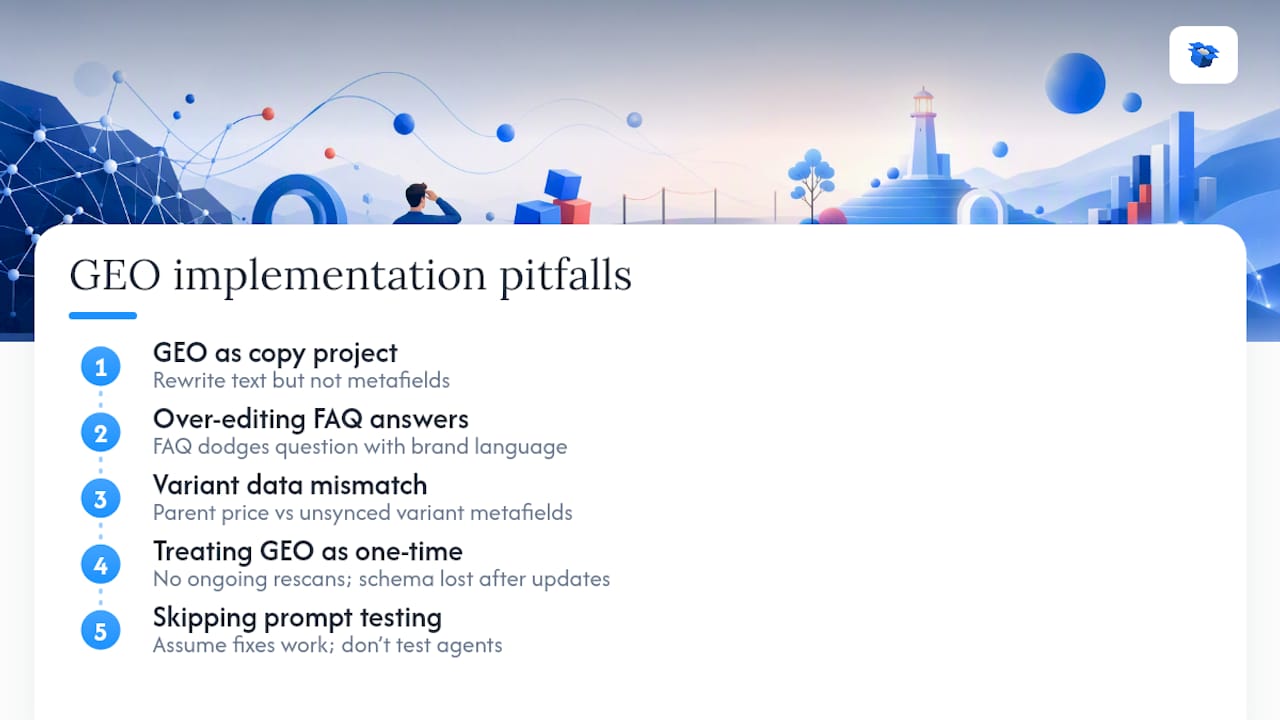
The most common mistake is treating GEO as a copywriting project instead of a data project. Merchants rewrite product descriptions to sound more “AI-friendly” without fixing the metafields underneath, and agents keep citing outdated specs because the schema markup still pulls from the old field.

Diagram of common pitfalls in GEO implementation

A second pitfall is over-editing FAQ answers into marketing copy. An FAQ answer that dodges the actual question with brand language gets ignored by agents looking for a direct fact, and it annoys the human shoppers who do read it.

Inconsistent variant data causes a quieter problem. When a parent product page states one price but a specific variant’s metafield hasn’t synced, an agent may cite the wrong number, and that mismatch erodes trust in your listings across future queries, not just that one.

Teams also tend to treat GEO as a one-time project rather than an ongoing discipline. A citation earned this quarter isn’t permanent; competitors update their listings, models get retrained, and your own theme updates can silently strip schema tags. Build rescanning into a monthly routine instead of a launch checklist you check off once.

Finally, many merchants skip prompt testing entirely and assume their technical fixes worked. Without testing actual buyer questions against actual AI agents, you’re optimizing against a checklist instead of against reality, and the two don’t always match.

10

How Are Real Shopify Stores Using GEO to Grow Sales?

How Are Real Shopify Stores Using GEO to Grow Sales?

The pattern across merchants who’ve moved fastest on GEO isn’t a single silver-bullet tactic, it’s sequencing: fix the data, then fix the copy, then measure.

A specialty outdoor gear retailer that rewrote its top twenty product pages with answer-first summaries and added FAQ schema saw those specific pages start appearing in AI-generated buying guide answers within a single sales cycle, driven largely by how measurably specific the new copy was compared to the vague copy it replaced.

A home goods brand that focused first on metafield completeness, filling in dimensions, material composition, and care instructions across its full catalog rather than rewriting flagship pages, found that fixing the data layer alone improved how consistently agents cited exact product specs, even before any copy changes shipped.

Merchants running Shopify Catalog with clean variant modeling report fewer instances of AI agents citing the wrong price or size, a problem that had quietly undercut trust in their listings before the fix. The through-line in every case is the same: the merchants who treated GEO as sequential, data first, then content, then measurement, saw more reliable gains than those who jumped straight to rewriting marketing copy.

11

What’s Next for Generative SEO on Shopify?

What’s Next for Generative SEO on Shopify?

Agentic Storefronts and the Universal Commerce Protocol point toward a future where AI agents don’t just recommend a product, they complete the transaction directly against a store’s data. That shifts GEO from a discovery problem into a transaction-readiness problem: your product data has to be accurate enough for an agent to act on without a human double-checking the price first.

Expect AI platforms to keep expanding query fan-out, breaking single shopper questions into more granular sub-queries that reward merchants with deep, specific content over broad marketing pages. Shopify’s generative recommender research already signals that sequence modeling and consistent product schemas will keep mattering more, not less, as these systems mature.

Voice and multimodal shopping queries, someone showing an agent a photo and asking “find me something like this,” will push image-attached structured data and visual attribute tagging further up the priority list. Merchants who already treat metafields as their source of truth will adapt to these shifts faster, since the underlying data model doesn’t need to change, only the surfaces reading from it.

The merchants who win the next two years of AI shopping won’t be the ones who reacted first to a single platform update. They’ll be the ones who built a data foundation clean enough to survive whatever surface comes next.

12

A Practical Playbook for Merchants, Not a Trend Piece

A Practical Playbook for Merchants, Not a Trend Piece

Most GEO advice online treats this like a brand-new discipline requiring its own team and its own tools from scratch. That’s overstated. The research behind this article points the other direction: a Shopify store with solid SEO fundamentals, complete metafields, and clean variant data is already 80% of the way to AI-ready, and the remaining work is narrow and specific, not sprawling.

The conventional wisdom that GEO means writing differently for robots also undersells the real work. Agents don’t reward “AI-friendly” tone, they reward factual density and structural clarity, the same qualities that make a page genuinely useful to a human comparing products at 11 p.m. on their phone. Chasing a mythical AI-optimized writing style is wasted effort next to fixing a missing dimension metafield.

If you do only one thing from this entire playbook, fix your data layer before touching your copy. A beautifully written product summary sitting on top of incomplete metafields will still get skipped, because the agent can’t verify the claims underneath the nice sentence. Data first, copy second, measurement always. That order isn’t optional, and it’s the one place most merchants get the sequence backward.

13

Get Your Shopify Store Ready for AI Agents

Get Your Shopify Store Ready for AI Agents

There are other paths here: a freelance SEO consultant, an in-house rewrite sprint, or a generic AI writing tool bolted onto your product descriptions. All of them require you to guess which fixes actually move citations. Ecentic replaces the guessing with a direct answer, running simulation diagnostics against your real Shopify catalog to show exactly which listings ChatGPT and Gemini skip, and why.

Ecentic

From there, the platform suggests specific rewrites tied to each gap, publishes approved changes to your store in one click, and tracks whether citation rates and AI-referred revenue actually move afterward. That closes the loop this article walks through, diagnose, rewrite, publish, monitor, without stitching together five separate tools yourself.

Start with a free product listing scan to see where your top pages stand against AI agents today.

14

Sources

Sources

  • The GEO Playbook: How (& Why) to Optimize for AI Discovery
  • The ultimate Shopify SEO and AI readiness playbook
  • The generative recommender behind Shopify’s commerce engine
15

FAQ

FAQ

Does Shopify Have Built-In SEO Tools?

Shopify includes native tools for meta titles, alt text, sitemap generation, and canonical URLs, plus Search & Discovery features for internal product recommendations, but merchants still need apps or manual work for advanced schema markup and metafield-driven structured data.

What Is Generative SEO and How Does It Work?

Generative SEO (GEO) is the practice of structuring content and data so AI agents like ChatGPT and Gemini can extract, trust, and cite specific facts as standalone answers, relying on structured data, answer-first copy, and FAQ schema rather than traditional keyword ranking signals.

How Much Does Shopify Take From a $100 Sale?

Shopify’s own transaction fees depend on your specific plan and whether you use Shopify Payments; third-party payment gateways carry an additional fee on top of your plan’s base rate, so check your current plan’s rate card rather than assuming a flat figure.

Is Shopify Still Worth It for Merchants Chasing AI Visibility?

Shopify’s server-side rendering, centralized Catalog data, and emerging Agentic Storefronts and UCP support give merchants structural advantages for AI discovery that custom-built stores often lack, making it a strong foundation for GEO work specifically.

Can Ecentic Help Identify Why AI Agents Skip My Products?

Yes. Ecentic’s simulation-driven diagnostics test how AI agents like ChatGPT and Gemini evaluate your actual Shopify listings and report the specific gaps, missing specs, weak summaries, thin FAQs, that are keeping a product from being recommended.

shopify ai publishinghow to improve Shopify SEOshopify generative seoShopify SEO strategiesgenerative SEO techniquesShopify SEO optimizationAI-driven SEO for Shopifyshopify geobest practices for Shopify SEOshopify ai recommendations
Back to blogGet started

Guides and research on winning AI shopping agents.

Get picked by AI

Ready to be the product agents recommend?

Install free on Shopify or WooCommerce and see your AI score in minutes.

Install on ShopifyInstall on WooCommerce
ecentic

Win every AI shopping agent's cart.

Built for the agent economy
Product
  • Features
  • How it works
  • Pricing
  • Product Listings
Platforms
  • Shopify
  • WooCommerce
  • Enterprise
Resources
  • Developer docs
  • API reference
  • Resources
  • Blog
  • Compare
  • UCP Validator
  • UCP Playground
  • Book a demo
Company
  • Support
  • Privacy policy
  • Terms of service

© 2026 ecentic. All rights reserved.

Made for merchants who refuse to be invisible to AI.